Emptiness has moved in next door
New publication: how states in former socialist world are emptying places, with lessons for Europe
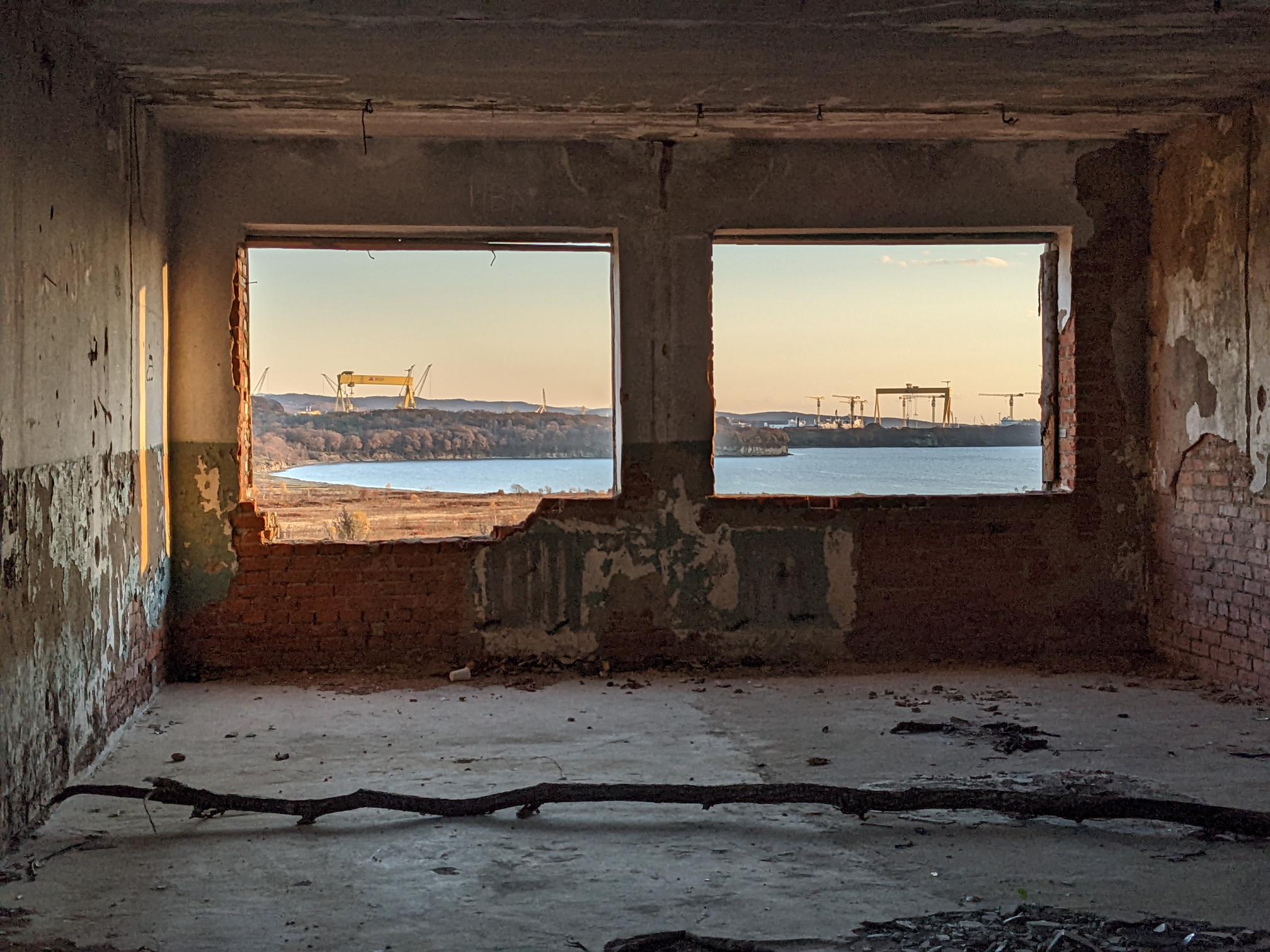
Factory cranes from a window in an abandoned building in a former military garrison in Bolshoi Kamen, Russia. Photo by Dominic Martin. Photo by Dominic Martin
The Background
Do you know of a remote town that is losing its inhabitants? Or a village that is not reachable by public transport? How about industrial ruins? Places expelled from global circuits of value production are increasingly common across Europe, and there is a growing body of research about what it means to live in such places. But there is still too little understanding of what such places can tell us about the spatial and social changes affecting us all.
The Project
EMPTINESS: Living Capitalism and Democracy after Postsocialism
Dates active: 2020-26
This project was funded by the European Research Council’s Horizon 2020 research and innovation programme
Principal Investigator: Dace Dzenovska, Associate Professor in the Anthropology of Migration,
The project was based at the Centre for Migration, Policy & Society (COMPAS), within the School of Anthropology & Museum Ethnography (SAME), University of Oxford.
The research publication Living Emptiness: Place, Power, and Meaning-Making from the Baltic to the Russian Far East (Stanford University Press) is available open access.
The Findings
Findings from this major project reveal how the intersecting forces of global capitalism, empire-building, and sovereignty produce emptying places and what the residents of such places have to say about what it means — and how it feels — to live there.
These insights, gained through ethnographic research in the Latvian borderlands, Armenian highlands, central Ukraine, and the Russian Far East, are captured in a unique collection of essays, videos, films, and images that conjure a multi-dimensional world of emptiness alongside analysis of place, power, and meaning-making. Findings show that:
- Emptiness is often the result of a political decision rather than an inevitable consequence of market forces. Border closure can affect people’s ability to make a living in the borderlands, while the institutionalization of neoliberal freedoms can lead to massive outmigration.
- Capital no longer needs a densely populated countryside to turn a profit. The people living in emptying places are not needed as workers, for no production takes place there. Instead, the places where they live may become attractive as reforested areas, militarized zones, or heritage sites.
- Local policy cannot reverse decline. Attempts to address decline with local-level policy can patch up quality of life but cannot lead to fundamental changes in the employment structure, border regimes, or service provision.
- Communities develop different ways of living with emptiness. Residents adapt their lives by repairing buildings with industrial scraps, foraging for food and building materials, remaking social relationships, and trying to make sense of the radically changing world around them. While there are many shared features across sites, there are also differences. In Russia, a community of Old Believers views emptying places as a spiritual refuge, while in Armenia, family and social networks, rather than state policies, help sustain communities and places.
- Emptiness has political consequences: people living in emptying places often have keen insights into governments’ strategies and are more inclined to seek political change.
Wider Implications
By making sense of life elsewhere, anthropology invites critical reflection on one’s own society.

Although conducted in post-socialist societies, where emptying has a specific history, the research offers important lessons for Europe at a time when different social groups, from retired industrial workers to students, feel that the state is abandoning them.
Dace Dzenovska, Lead Researcher and Associate Professor in Anthropology of Migration at the University of Oxford, said: “Although the research focuses on what we call ‘post-socialist emptiness’, it can serve as a lens for thinking about ‘left behind’ places in the United Kingdom. For example, why is it that in Eastern Europe deindustrialisation leads to outmigration, whereas in places like Blackpool, Lancashire it has resulted in a concentration of poverty? By making sense of life elsewhere, anthropology invites critical reflection on one’s own society.”
The research shows that paying close attention to people’s experiences of living emptiness offers important insights into political disillusionment, the appeal of radical political alternatives, and the growing sense among some communities that they have been excluded from the prospect of a better collective future.
Dace Dzenovska added: “While the decline or abandonment of places has happened before, today’s emptiness comes at a time dominated by finance capitalism, worldwide securitization, and the disappearance of the promise of a better future. Instead of being incorporated into the market economy and welfare networks, as was the case in the heyday of modernity, people and places are being expelled from circuits of capital and care of the state. Some people can move, while others are stuck in place. This makes the lived experience of emptiness strikingly new.”
Videos
Gallery